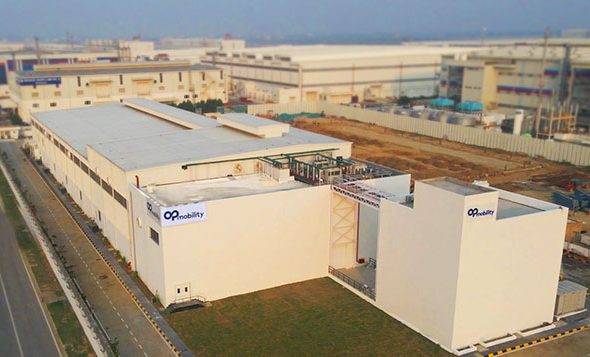
Given the automotive industry’s growing complexity, the ability to develop end-to-end digital continuity has become a key factor in performance. For a long time, data was fragmented across multiple tools and processes; today, the goal of digital manufacturing is to transform the vast amount of available data into useful insights which enable faster decision-making, better collaboration, increased efficiency, and greater time savings.
A few years ago, industry standards and customer demand led the sector to develop and launch a new vehicle every 5 years, on average. Today, development timelines have been shortened by customers to be ready in 15 months. This shift has redefined the requirements for the entire value chain and imposes a level of agility which the way of working and the tools of a Group such as OPmobility must be able to accommodate.
“To address these new challenges, digital continuity is emerging as the new guiding principle for industrial operations.” Sandrine Ledru, Executive VP and Chief Digital & Information Officer at OPmobility
End-to-End Digital Continuity
To address these challenges, digital continuity is emerging as the new guiding principle for industrial operations. Long scattered across various tools, it is now structured and shared throughout the product lifecycle thanks to digital continuity. By linking design, validation, and production, it connects teams, streamlines communication, reduces data transfer errors, and breaks down silos.
In line with this approach, OPmobility formed a partnership with Siemens in 2025 to deploy their Teamcenter X across its 40 R&D centers. This Product Lifecycle Management (PLM) solution ensures data continuity, from customer specifications all the way through to production. Ultimately, 4,000 engineers, representing approximately 10% of the Group’s workforce, will work on this shared platform, which is connected to ERP systems and production execution tools.
Simulate Before Producing
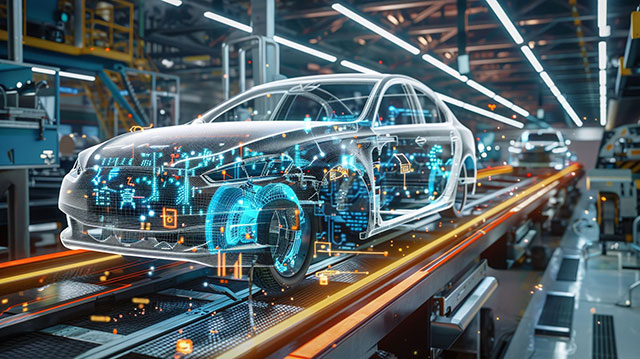
Digital continuity and data access pave the way for digital twins. Solutions, production lines, and plants can be tested virtually before implementation: material flows, AGV (Automated Guided Vehicles) movements, operator workstations, and robotic paths.
This ability to anticipate shorten development cycles, enables successful deployment on the first attempt, avoids bottlenecks and within the required timeframe, reduces prototype-related costs, improves management of constraints early in the process, and optimizes information sharing across entities. The overall set-up of a production line, which previously could take 2 years, can thus be reduced to 1 year.
“By creating one reliable source, PLM facilitates and accelerates access to information, not only for designers but also for engineering and manufacturing teams. The more teams are able to access the right data on their own, the more efficient and agile we become.” Erik Torres, Product Designer at OPmobility.
Combining Artificial Intelligence and Performance
In these digital environments, artificial intelligence is a tremendous catalyst. It will eventually incorporate rules and areas of expertise in the digital twins of plants to explore a wide range of scenarios and recommend the best configurations. Depending on the project, this synergy could result in an acceleration of around 30% in the time needed to manufacture solutions.
It will also be involved very early on, during the engineering phase. With the support of NVIDIA’s technologies, for example, OPmobility is using artificial intelligence in its bumper design to speed up development cycles, strengthen engineering capabilities, and respond more quickly to customers’ needs.
“When we start a new project, the idea is to be able to access existing information rather than starting from scratch. The strength of PLM lies in its ability to centralize information and enable all departments, throughout the various stages of a project, to share the same data, in one place, and in real time, ensuring our technical decisions are sound.” Frédéric Gelve, Design Engineer at OPmobility
A Long-Term Digital Transformation
Digital transformation is driven first and foremost by a practical need: to make data useful, accessible, actionable and reliable at every stage of the product lifecycle, for everyone. By integrating specifications, design, validation, and production into a continuous workflow, PLM turns raw data into a decision-making tool. This solution enables an engineer in the United States, a production line manager in China, or a customer in France to work from the same database in real time.
With shared practices for organizing data, tracking tasks, and optimizing knowledge in real time, PLM becomes a means of supporting collaboration, while also serving as an industrial knowledge database that captures improvements from the field for the benefit of a global network.
“PLM is not just a new tool: it enables project teams to adopt shared ways of working, leading to better organization, increased visibility regarding CAD-related tasks, and more effective collaboration.” Shubhada Salunkhe, CAD Engineer at OPmobility.
By placing data at the heart of operations, digital continuity enhances OPmobility’s agility, efficiency, and resilience. It enables teams to make quick and sound decisions, better leverage existing resources, and focus on activities with higher added value. More than just a technological advancement, it has become the backbone of OPmobility’s industrial performance.
Opened in 2017 in South Carolina, the OPmobility plant in Greer exemplifies this digital continuity. Across 64,000 m², more than 800 employees produce large exterior body parts. The integration of digital tools has made it possible to link planning and purchasing systems, display the status of each machine in real time, and immediately diagnose any anomalies.
“We do not just manufacture parts: we are laying the foundations for the future of automotive manufacturing. Our digital transformation has made us more efficient and more responsive to market needs, allowing our teams to focus fully on what creates the most value: innovation, expertise, and customer service.” Lon Miller, Supply Chain Manager, Greer site, Exterior & Lighting Business Group